Productivity
Working with Millennials: Expert Tips, Stereotypes and Pure Facts

My close friend, a baby boomer in the concert business, once told me something with absolute conviction.
“I’ve hired plenty of millennials. They’re useless.”
“Hard to please.” “Impossible to understand.” “Lazy.” “Entitled.” “Job hoppers.”
He said it so confidently that for a moment I wondered: is he right?

That conversation happened years ago. Now those so-called job-hopping millennials are senior managers, HR directors, founders, and C-suite executives. Many of them have teams of their own. They are not being managed anymore – they are building the systems.
All of this raises a few questions for HR in 2026. How do we actually manage millennials in the workplace, based on data rather than stereotypes? How do we build strong teams with them? Is there a way to understand this age group without rolling our eyes – and maybe even enjoy the process?
After digging into research and workplace studies, I want to share three practical insights for HR leaders and managers – based on large scale reports, behavioral research, and lived experience.
Who are Millennials?
The best definition of millennials I’ve found so far is given by Pew Research Center.


Definition of millennials
In a nutshell, millennials are those who came into adolescence in the 2000s. The year 1996 is usually marked as a final birth year for them. Later, GenZers stepped into the game, while before the 1980s Baby Boomers were in the spotlight.
Let’s zoom out more for a bigger picture. (Just for the record, GenY and Millennials mean the same age cohort).

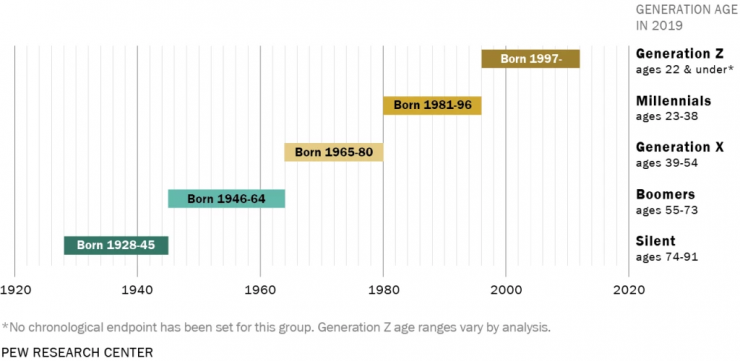
pewresearch.org
Among the most important facts about millennials, I’d outline the following:
- They are the largest generation in US history – until Gen Z
- They entered the workforce during or after the 2008 financial crisis, facing lower employment and starting incomes than prior generations
- Many delayed major milestones – homes, cars, marriage, children – due to financial pressure
But here is what changed. By 2026, millennials make up approximately 35% of the global workforce. Many hold senior roles. The “entitled job hopper” narrative is increasingly hard to defend when you look at the numbers: average millennial job tenure has grown steadily over the past decade as this generation has matured into mid-career stability.
The pandemic also permanently reshaped their expectations. Flexibility, work-life balance, and psychological safety are no longer nice-to-haves for this cohort – they are baseline requirements.
3 tips on how to approach millennials
1) ‘Lazy’, ‘sloppy’ and ‘unhappy’? Abandon stereotypes.
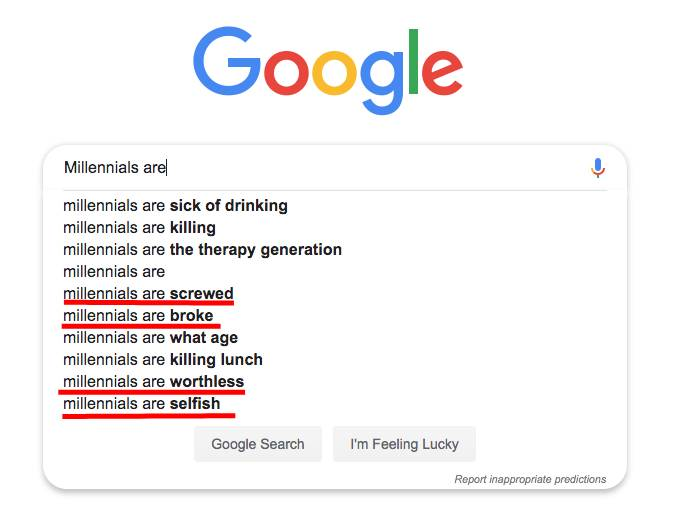
If you type “millennials” into your Google search bar, “screwed,” “worthless,” “selfish,” and many other not-so-flattering adjectives will probably follow your query. The question is: do these descriptions jibe with the facts?

The EY Generational Study proves millennials are not some sloppy ego trippers. Actually, they are highly committed to their careers. Some researchers even call them “Generation Go” – companies need to keep pace with them or risk losing out on their talent.
A Harvard Business Review study found that 82% of millennial employees reported significantly higher job satisfaction when their work aligned with their personal values – compared to 61% of Gen X and 48% of Baby Boomers.

This suggests something important.
Millennials are not disengaged – they are selective. They want meaning alongside income.
If you are a CEO, HR director, or team lead trying to retain millennial talent:
- Communicate clearly about mission and impact
- Demonstrate real corporate social responsibility
- Show how individual roles contribute to a larger purpose
- Recognize achievements consistently
As researcher Ashira Prosac has noted, corporate social responsibility is a top priority for Millennials. The more a company gives back to the community, the higher employee satisfaction tends to be across this group.
In case a millennial is your peer, e.g., a colleague, be sure to look for a win-win solution in every situation – frame collective choices around shared benefit.
Most importantly, avoid stereotypes that act as self-fulfilling prophecies – when leaders expect disengagement, they often create it.
2) Provide no rigid framework. Embrace freedom.
In my circle of acquaintances, 6 in 10 people work hybrid or fully remote jobs. This reflects something fundamental – millennials value autonomy in how, where, and when they work.
So here’s a tip for anyone in a managing position. The Global Gen Z and Millenial Survey from Deloitte consistently shows that flexible work arrangements rank among top drivers of engagement and retention for this generation. This is not a pandemic-era blip. It’s a structural preference.
Flexibility can include:
- Hybrid or remote options as the default, not the exception
- Flexible hours instead of rigid nine-to-five schedules
- Outcom-based performance measurement rather than time-based monitoring
- Task variety and genuine autonomy in work execution
Experts from Stanford University even suggest you might help millennial workers pursue their side hustles! It can actually benefit everyone in terms of engagement and productivity.
There’s one caution, though: real freedom requires clear structure. Set measurable goals, establish KPIs, and maintain accountability. Millennials don’t want chaos – they want trust combined with clear expectations. That combination is what actually produces results
3) Connect – online and offline. Set up communities.
Do you remember your first instant message ever? Probably it was just ‘Hi’ or ‘All right?’. But I bet you never thought it would be a milestone for your communication.
First, there were PowWow, ICQ, or AOL Instant Messenger. Then Facebook, WhatsApp and HipChat came into the scene. The rise of social media and chat apps fell in the 2000s, which is exactly the time when millennials stepped into adulthood.

In a word, millennials are the first digital natives, as emphasized in the Goldman Sachs research. In this light, being connected might be the third most important thing for them, apart from making a positive change and having enough freedom.
How do we connect with millennials? Apart from understanding and emphasizing with them, we might get to know them a little bit more. It doesn’t necessarily mean being their best friends. But maybe we could become a bit closer to each other instead of staying in separate cubicles forever.
A 2024 workplace study by Gallup found that millennials with strong workplace friendships are more than twice as likely to stay with their employer long term. Connection is not a culture perk – it is a retention mechanism.
So what does this look like in practice?
- Create opportunities for voluntary team bonding
- Invest in collaboration tools that foster interaction, not just task tracking
- Support employee resource groups and shared interest communities
- Encourage transparent communication across leadership levels
Chris Tuff in his book ‘Millennial whisper’ recommends connecting with millennial teammates on social media. If the idea of that makes you uncomfortable, Tuff argues, that discomfort is itself the signal: it means you need to invest more in those relationships.
Better connections lead to a greater sense of camaraderie, which is no less important for millennials. This doesn’t man to become the best friends with everyone, it means building trust and psychological safety. At this point, company culture is no longer a cosmetic layer; it’s a strategic infrastructure what prevent turnover.
When millennials are the managers
Here is the part that most “working with millennials” articles still miss in 2026.
Millennials are not just employees anymore. They are increasingly the people making hiring decisions, setting team culture, approving budgets, and shaping organizational strategy. HR professionals are, in many cases, now working for millennial leaders – not just alongside them.
Research from the Center for Creative Leadership identifies consistent patterns in how millennial managers lead:
- Collaborative decision-making: most prefer consensus-building over top-down directives
- High feedback frequency: regular check-ins with direct reports, often weekly
- Digital-first communication: instant messaging as the default channel
- Active boundary-modeling: a tendency to visibly protect work-life balance for their teams
These traits create realadvantages – and real friction. Millennial managers may clash with older employees who expect formal hierarchy, while simultaneously navigating Gen Z employees who want even more autonomy and purpose than millennials themselves did at that career stage.
Wrapping up and going beyond age concepts
The millennials your organization hired a decade ago have grown up. Maybe it’s time the conversation about them did too. Still, the core three principles for working with them remain the same.
- Let go of the stereotypes. Studies show millennials are highly committed to their careers and keen to have a positive impact on their community. Keep that in mind when communicating or negotiating with your co-workers in this age group.
- Be flexible. Freedom and ability to change in order to suit different life contexts are of the essence for millennials. Embrace flexible work approaches and diversity at the workplace.
- Connect with millennials and build some great communities. Being the first digital natives, they strive for the sense of camaraderie. You might consider getting in touch with them on social media more often.
At the same time, whatever age cohort we all are from, the differences between us might not be that important. Maybe next time you are interacting with a millennial, here’s what you can do.
Put aside anything you know about them. Take a deep breath and see a usual, regular human being in front of you. Don’t pay too much attention to their age at birth. They are just the same person as you. They want to benefit the world, strive for career advancement. They’d like to have a good salary and their achievements to be acknowledged. You might differ in some ways, but you are also similar in many ways. So you don’t have to bother much about the distinction between you two. Breathe, meet, connect… Chances are, you’ll enjoy your collaboration much more now.